Where to Get New Year's Mochi in Gardena This December
November 19, 2026
November 19, 2026
On Western Avenue in the middle of Gardena, two mochi shops stand about 250 feet apart. Their signs are easy to miss. The Los Angeles Times called Sakura-Ya and Chikara Mochi two of the only traditional Japanese mochi shops in Los Angeles in 2025, and South Bay customers have bought their mochi and manju there for decades. One block away is Meiji Tofu, which makes soy milk and tofu fresh every day. Across the street is Otafuku, where the Akutsu family has made Tokyo-style soba since 1997.
Late December is when this block matters most. It is also when walking in without a plan works least well. Both shops make their sweets by hand and in small amounts, and both are known for selling out, so December here starts with a phone call.
The two shops share a block on purpose. In 2024, Frank Shyong of the Los Angeles Times reported that Masayasu Fujita trained at a mochi shop in San Jose in the 1950s. He then moved his family to Gardena so his teacher would not lose business. He opened Sakuraya in 1960, and his sons Mas and Yuki have worked there since. The same story says the Fujitas were close friends with the owners of Chikara Mochi just down the street, and the two families talked about how to avoid taking business from each other.
That is why a Gardena family can keep buying from both shops for different reasons. The two cases hold different sweets.
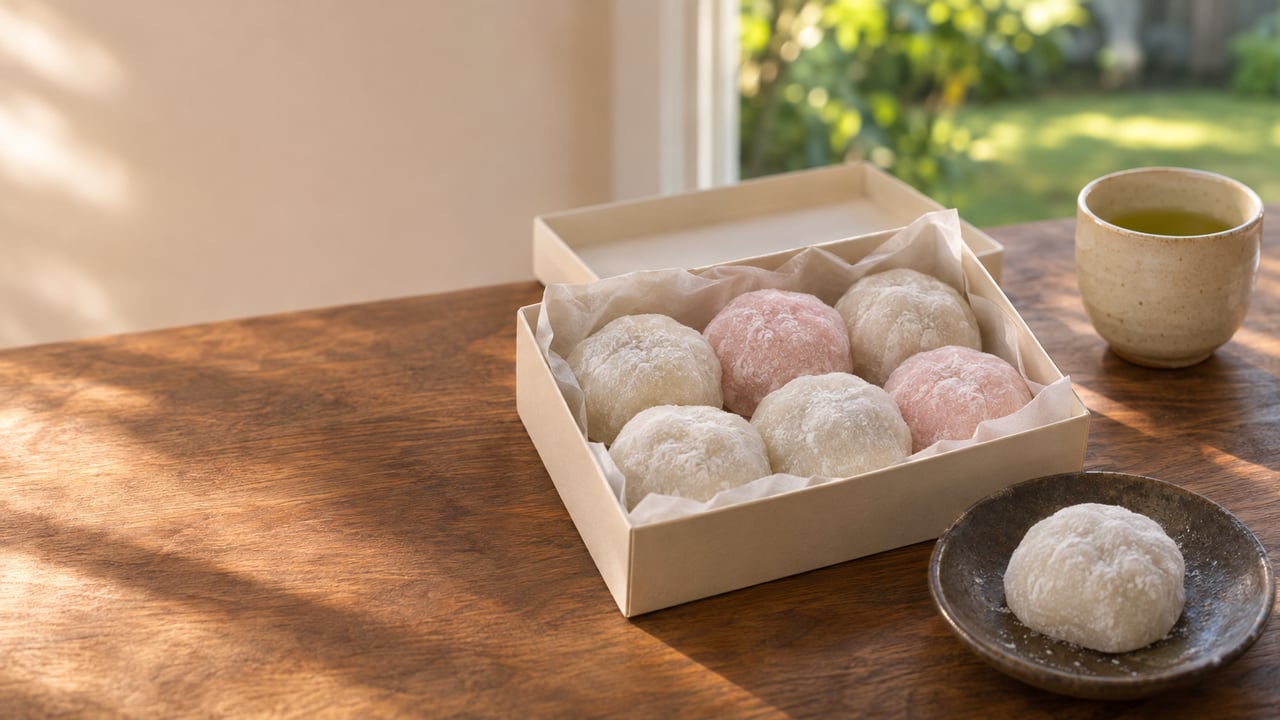
Sakuraya's mochi is unusually soft. The Times explained that the shop uses a blend of rice flours and other starches instead of pounded rice, so the mochi stays soft for days. Customers often pack it for long flights as gifts for family out of town. The shop's own website lists white, kinako, pink, green and orange mochi, kiku and kuri manju, ohagi, imo manju, and maruyaki filled with either peanuts or chocolate chips. At a Gardena Valley Japanese Cultural Institute festival fundraiser, the Times columnist found that everyone he spoke with seemed to have sentimental memories of Sakuraya.
Chikara Mochi leans toward wagashi, the small sculpted sweets often shaped like flowers. The 2025 Times guide describes a cash-only shop with one bamboo bench in the corner, where each box of sweets gets a sticker label. It lists daifuku, chestnut-shaped kuri manju filled with lima-bean paste, potato manju and seasonal wagashi. It also mentions yaki dango, grilled mochi balls in a soy glaze that may be the shop's only savory item.
Supply explains why calling ahead matters in December. At Sakuraya, Mas Fujita makes all the mochi and bean fillings by hand. In 2024 the Times reported that on the busiest days he may start at 4 a.m. and make about a thousand pieces in a shift. The beans take the longest, because they simmer for hours and then need even longer to cool. The same story described a shop that has never advertised, has no line, and still almost always sells out.
Chikara Mochi has the same pattern. In a 2019 profile, The Rafu Shimpo reported that the shop often sold out within two hours of opening and that holiday gift orders came in one after another. Chikara started in 1985 as a wholesaler near 7th and Stanford in Los Angeles. It sold only wholesale for about two years, then moved to Gardena and opened for retail. The paper ran an older photo of the year-end workroom with more than twice the usual staff packing New Year shipments. An English version of the profile is on Discover Nikkei.
Both shops make everything by hand, and both have a history of selling out before holiday orders arrive on top of regular business. Sakuraya's website tells customers to call to reserve their favorites, and it has posted a notice about New Year mochi. The numbers to save are (310) 323-7117 for Sakura-Ya at 16134 S. Western Ave. and (310) 324-5256 for Chikara Mochi at 16108 S. Western Ave. Call before you drive over. Holiday weeks can change a small shop's hours, and either case can be empty by midmorning.
Chikara Mochi changes its case with the calendar. The 2019 Rafu profile said the shop decorates wagashi for Halloween and Thanksgiving in the fall, then adds trees and holly for Christmas. For New Year, the paper photographed twelve sweets on a new-spring theme, including nanten berries, winter camellia, a rabbit and small plums. The Times wrote in 2025 that the shop's offerings change often because everything is made from scratch. This year's New Year selection depends on what the shop makes for the season, so ask when you call.
The Rafu profile also reported that the shop's customers had changed in the years before 2019. Photos of its wagashi shared on social media brought in new buyers. The shop responded with flavored mochi and brighter colors while keeping its traditional pieces. So a Chikara box for the New Year table can include strawberry-filled mochi next to a camellia wagashi.
Mochi is one part of the New Year table. For the full layered osechi box, the Gardena option is Tokyo Central at 1740 Artesia Blvd. The store calls itself its flagship and says it has the widest selection of Japanese groceries in the South Bay.
The store's product page for the New Year's Premium 3-tiered Osechi Box with Snow Crab currently lists it as preorder only and limited in quantity. The price is $349.99, orders close Monday, Dec. 28, and pickup is Thursday, Dec. 31 or Friday, Jan. 1, from noon to 6 p.m. The page says trays are made fresh to order, need at least four days' notice, and some need more. Choosing a store shows its earliest pickup date, and the cart confirms the exact date. Tokyo Central Gardena is one of the pickup stores. The top tier of that box includes simmered octopus, salmon roe, boiled lobster, kombu-wrapped herring and surf clams, and it comes with two boiled snow crabs.
The store keeps shorter holiday hours. Tokyo Central Gardena normally opens from 8 a.m. to 10 p.m. every day. On Thanksgiving, Christmas Day and New Year's Day it closes at 7 p.m. That includes Thanksgiving next Thursday, Nov. 26, and New Year's Day for anyone picking up osechi.
Laid out by date, the season looks like this:
For a hands-on version of the holiday, the Gardena Valley Japanese Cultural Institute at 16215 S. Gramercy Pl. has an Oshougatsu program page. It describes a short talk on New Year traditions, a reading of the children's book Thank You Very Mochi by Paul Matsushima, and a mochi-making demonstration families can join. The page links to registration and lists (310) 324-6611 for questions, so call for the next date. The institute and Sakura-ya have a long connection. The institute's Winter 2026 newsletter lists Sakura-ya among the businesses that donated in 2025.
The 2024 Times column explains why some households make the extra stop when a grocery store sells mochi. Stony Furutani, a longtime Gardena resident, told the Los Angeles Times that going to the small shop and talking with Mas "shows extra effort." His daughter Emily called Sakuraya's mochi "the thing you want to bring to the potluck." The column says that for 64 years Sakuraya's sweets have been a main draw at weddings, funerals and baby showers. A New Year table belongs on that list. With two small shops that often sell out on ordinary days, an order placed in late November or early December has the best chance of being filled.
If you are hosting New Year this year, Otafuku and Meiji Tofu are a short walk from the two mochi shops, so one Western Avenue errand can cover mochi, tofu and a bowl of soba. For more about the city outside the holidays, see our Gardena neighborhood guide and our look at Gardena after dark.
At The Jones Group Realtors, we believe the family shops behind a neighborhood's traditions are a large part of what makes it home. If you have questions about your Gardena home or what it would be worth in today's market, schedule a free consultation.
Stay up to date on the latest real estate trends.
Get assistance in determining current property value, crafting a competitive offer, writing and negotiating a contract, and much more. Contact me today.