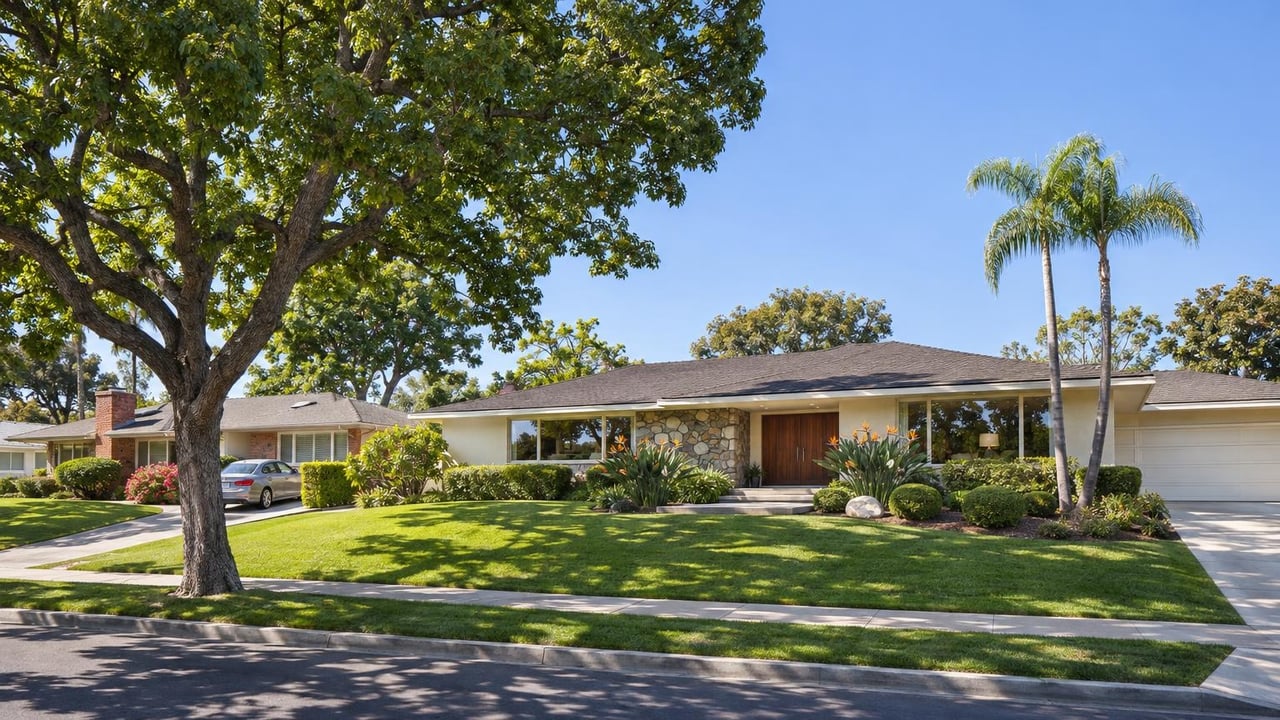
Old, Upper or Lower Ladera: How to Read a Ladera Heights House by Its Street
November 26, 2026
In 1954, Homer Valentine bought two lots next to each other on Garth Avenue for $7,500 each. Garth was one of the first streets in Lower Ladera that the Los Angeles Investment Company opened to builders. The story comes from Tony Valentine Construction's company history, which also recalls that Bank of America's Crenshaw branch came to Valentine to finance homes in the new development. Valentine later built a house at 5857 Garth for his son Lynn, and a neighboring family hired him to build on the lot next door.
That purchase shows how Ladera Heights was made. One company owned the land and sold it in phases, a tract at a time, to "scores of builders," in the words of a 1955 Los Angeles Times ad quoted in the county's Westside Area Plan historic context statement. Each builder had its own designers and its own idea of what buyers wanted. Development ran from 1946 to 1964. As a result, Ladera Heights is less one housing market than a set of streets built a few years and a few builders apart. If you're comparing homes in Ladera Heights, start with which section the house is in and which street it's on. The ZIP code tells you much less.
The neighborhood's informal names line up with its building phases. Los Angeles County's Westside Area Plan historic context statement gives the boundaries and dates.
| Section | Where it sits | When it was built | What the first phase produced |
|---|---|---|---|
| Old Ladera | South of Slauson, east of La Cienega, west of Ladera Park | Subdivided 1946, first offered 1947 | Ranch homes on wide lots, plus duplex and triplex lots |
| Lower Ladera | South of Slauson, between Wooster Avenue and La Cienega | Builders from the early 1950s; southern tracts 1960 to 1964 | Builder and custom homes, plus 1960s apartment complexes in the southeast corner |
| Upper Ladera | North of Slauson, between La Cienega and Shenandoah Avenue | 1956 and 1957 | Ranch and Mid-Century Modern homes, many of them custom |
Each section reflects what the Los Angeles Investment Company was selling at the time, and that changed as the company moved west.
The first tract, Tract 12650, had 174 parcels spread across three jurisdictions: the City of Los Angeles, the City of Inglewood and unincorporated Los Angeles County. The 1947 offering had 124 single-family homes on wide lots, which suited the Ranch houses then in fashion. The company appears to have built some of those homes on speculation and also sold bare lots.
The same offering included 15 duplex lots and 20 triplex lots. They were marketed as investments: an owner could live in one unit and rent out the others. Garden apartments went up in Ladera Heights in the same period, including Cienega Village at 5710 S. Fairfax Avenue and the Ladera Townhouse at 6233 S. La Brea Avenue, both from 1950. Architect John C. Lindsay designed the Ladera Townhouse. By 1951, the company had developed 592 sites east of La Cienega Boulevard. Independent builders worked alongside it, including Milton Kaufman, whose firm built a group of homes on S. Kings Road.
For a buyer today, this explains a lot about Old Ladera. The wide lots are original to the tract. The small multi-unit buildings were part of the plan, not later infill. And because the parcels crossed three jurisdictions from the beginning, it's worth confirming early in a search which jurisdiction a particular Old Ladera address falls under.
Lower Ladera came together street by street. Garth Avenue opened early. Springpark Avenue was the last street the company opened, and Lynn Valentine recalled that Reuben Ingold, who led the company, had sold so many lots that "he had to act as a referee with all the builders." By then Valentine could buy lots on only one side of Springpark.
The Valentine history also shows how individual builders shaped their own houses. In View Park, Homer Valentine had built two-story homes. When Ladera opened up, the company switched to single-story houses. Lynn Valentine said they tried to get every corner lot in a new tract and often gave the corner homes four-car garages. Valentine was also one of the first builders to sell homes with the landscaping already finished, and he put remote garage door openers in his houses beginning around 1949. "We tried to start a house every two weeks in Ladera," his son recalled. The county's historic context statement credits that pace with giving Ladera Heights its large concentration of Mid-Century Modern homes.
Wooster Avenue, on the western edge, was sold on its outlook. Lots there overlooked the 36-hole Fox Hills golf course, and the family history says buyers loved the view, though some asked, "How do you know they are going to keep the golf course?" The homes sold quickly anyway. The history also notes that the course was later redeveloped, and shoppers at Fox Hills Mall may be standing on an old green. The county statement also singles out the westernmost parcels for their view over the course and notes that Valentine built several homes on Wooster.
The southeast corner of Lower Ladera was built differently. Along Fairview Boulevard and Springpark Avenue there's a group of 1960s apartment buildings with 10 to 20 units each, some arranged around a pool and patio. Samuel Wacht, AIA, designed two of them, at 6707 Springpark Avenue and 5376 Fairview Boulevard. In other words, Lower Ladera includes builder-run single-story streets, view lots on the western edge and a small cluster of mid-century apartment buildings, all within a few blocks.
Upper Ladera was built out in 1956 and 1957, after the company had shifted toward custom homes. The county statement names specific architect-designed houses in Upper and Lower Ladera. The Linnell Residence at 6443 S. Halm Avenue was designed by Charles W. Wong in 1965. Across the street, the Engleman Residence at 6440 S. Halm Avenue was designed by Paul Bennet, AIA, in 1964. Valentine often worked with Wong and with Robert L. Earl on custom homes.
The Valentine history describes a Wong design on 61st Street with a raised-center flat roof, a four-car garage and a pool. Earl met Valentine while working as a young draftsman in a small office in Leimert Park. He later earned his AIA credentials and designed estate homes across Southern California and abroad. In the family history he says, "I still love the Windsor Hills and Ladera Heights areas. The homes and grounds are so well kept up."
Two points follow for buyers. First, when a listing names an architect or a known builder, that can often be checked against the record, and it's part of what makes one Upper Ladera house different from the one next door. Second, not every house in the hills dates from that first wave. A 2018 Los Angeles Times neighborhood profile noted that many houses in the hills were built after the 1970s.
The most recent market figures come from the California Association of Realtors' October 2026 report, released November 17. In Los Angeles County, the median sold price of an existing single-family home was $955,090 in October 2026. That was 4.0% below September's $994,670 and 0.6% below October 2025. County sales rose 5.7% from September to October but were 17.5% lower than in October 2025. Statewide, homes sold in October for a median of 98.5% of list price.
C.A.R. notes that a median price can be affected by the characteristics and sizes of the homes that sold in a given month, so a 4% county move in October tells you about that month's mix as much as about value. The same thing happens on a much smaller scale in Ladera Heights. In a given month, the 90056 median depends on whether the homes that closed were ranches on wide Old Ladera lots, single-story builder homes on Garth, a view lot on Wooster or an architect-designed house on Halm. That's why the useful comparisons for a Ladera house are recent sales from the same section, built in the same period, ideally by the same builder. A ZIP-code median, or the county trend line, can't do that job.
Ladera Center opened in 1963 on 15 acres at Centinela Avenue and La Cienega Boulevard. It was built by the Los Angeles Investment Company and designed by the architect Stiles Clements, and it has been substantially altered since. Like Old Ladera, it crosses a jurisdiction line: a 2024 county supervisor's newsletter put about one-third of the center in the City of Los Angeles and two-thirds in unincorporated county territory.
Each side follows a different plan. The county adopted its Westside Area Plan on March 11, 2025, and it's the main planning document for the unincorporated Westside communities. On the city side, the Westchester–Playa del Rey Community Plan in effect dates from 2004, and the city is updating it. A February 2026 City Planning update presents the proposed land-use map as a draft. According to Ladera Matters, the draft would change the city-side portion of the center from a Regional Center to a Community Center. For buyers looking at Upper or Old Ladera near the center, the long-term plan for that corner is still being decided.
Is Ladera Heights in the City of Los Angeles? Most of it is unincorporated Los Angeles County. The original Old Ladera tract, though, was laid out across the City of Los Angeles, the City of Inglewood and county territory.
Is the Ladera Heights Civic Association an HOA? The Ladera Heights Civic Association describes itself as a dues-funded 501(c)(4) civic association, founded in 1955, that represents owners and renters across ZIP 90056.
Which streets were the last to be developed? Springpark Avenue was the last street the Los Angeles Investment Company opened in Lower Ladera, and the southern Lower Ladera tracts were built between 1960 and 1964.
For a fuller comparison of nearby hillside neighborhoods, see our guide to choosing between View Park and Ladera Heights.
Greg Jones has been a broker in Los Angeles since 1987, and sorting a Ladera house by section, era and builder is how he picks the recent sales that actually compare to it. If you're weighing a house on Garth, Halm, Wooster or Springpark, or want to know how your own Ladera home lines up against its true comparables, The Jones Group Realtors can help. Schedule a free consultation.
Stay up to date on the latest real estate trends.
Get assistance in determining current property value, crafting a competitive offer, writing and negotiating a contract, and much more. Contact me today.